
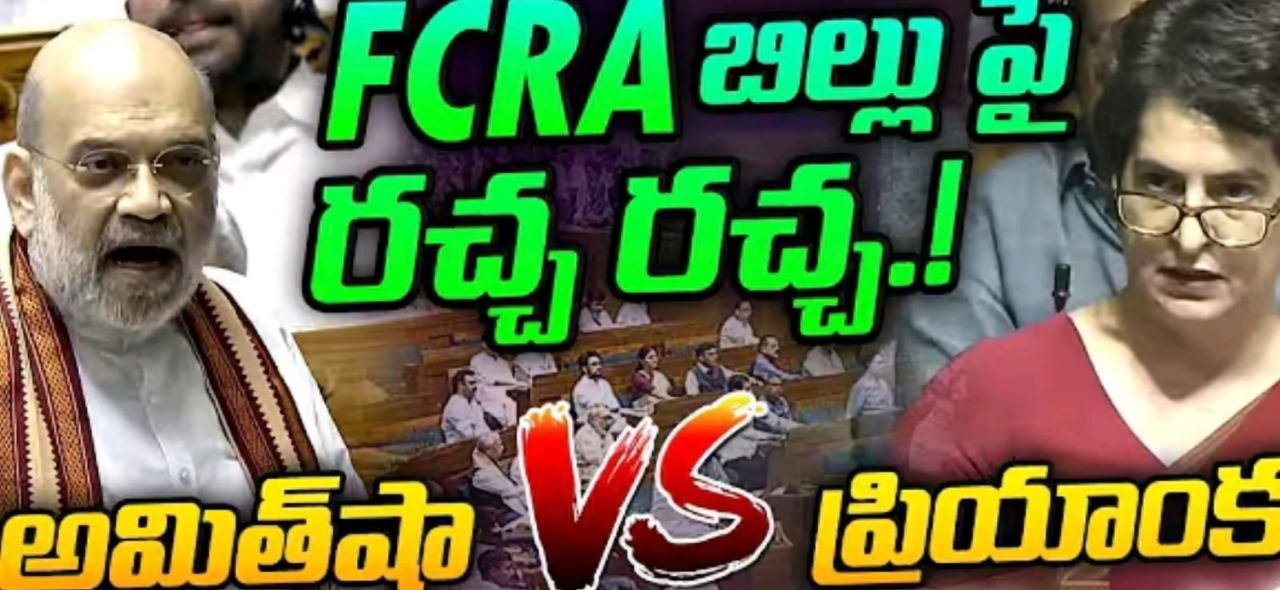
The Foreign Contribution Regulation Act (FCRA) amendment bill stoked heavy political heat during the monsoon session of Parliament, according to Trinet News (August 13, 2026, by P. Nageswara Rao). Intense arguments broke out between the ruling and opposition parties over the bill, which relates to government oversight of assets and fund utilization by entities and NGOs receiving foreign funds.
While the Congress strongly reacted to Union Home Minister Amit Shah's stance, Congress MP Priyanka Gandhi also firmly questioned the government. FCRA stands for the Foreign Contribution Regulation Act. It is intended to monitor whether funds coming into organizations in India from abroad are used legally and transparently. The 2026 amendment bill was introduced in the Lok Sabha on March 25.
The bill notably proposes a special mechanism for managing foreign funds and assets related to an organization when its FCRA registration is canceled or expires. According to the government's argument, more effective oversight is necessary to prevent foreign funds from being used against national interests. The government states that the main objectives of the bill are to increase transparency and accountability regarding foreign donations, prevent the misuse of funds, and take action against organizations violating regulations.
The central government has already launched a new phase-2 FCRA online portal to make the FCRA system more technological. However, the opposition is expressing severe objections to the bill. Opposition members are concerned that the government may assume sweeping powers, leading to excessive control over the activities of NGOs and civil society organizations.
Specifically, the opposition objects to provisions that allow government control over an organization's assets if it lacks FCRA registration or if it gets canceled. This very issue sparked a heated exchange between the ruling and opposition benches in Parliament, with Congress leaders demanding the complete withdrawal of the bill.
On the other hand, instead of immediately passing the bill, the government moved forward to refer it to a Joint Parliamentary Committee (JPC) for further scrutiny. On Wednesday, the Lok Sabha referred the bill to a 31-member JPC. Crucially, sending the bill to the JPC has halted its immediate passage into law.
The committee will examine every aspect of the bill, gather opinions from various sections, and suggest necessary amendments. Therefore, the opposition views this as some relief, while the government describes it as a step enabling broader discussion. Priyanka Gandhi's role has also become a talking point in this context.
Having questioned the government on various issues in Parliament over the past few days, she has been at the forefront of opposition protests demanding that Union Home Minister Amit Shah provide answers. She previously stressed that a response from the Home Minister was necessary to resolve the deadlock in Parliament. However, viewing the discussion surrounding the FCRA bill merely as an 'Amit Shah versus Priyanka Gandhi' battle would not be accurate.
This pertains to larger questions: To what extent should foreign funding be regulated in the country? How much power should the government have? How much freedom should NGOs enjoy? Foreign funds also play an important role in social service. There are organizations that legally utilize foreign donations in many fields such as education, healthcare, disaster relief, welfare of the poor, research, and social service.
Therefore, a balanced approach is needed that does not cause unnecessary trouble to honestly functioning organizations while taking strict action against those misusing funds. The government's points regarding national security and economic transparency cannot be ignored either. There must be clarity on where massive foreign funds are coming from, who is giving them, for what purpose, and how they are being spent.
If foreign funds are used for activities violating the country's laws, the government must take action. At the same time, there must be limits on government powers. Before taking action against an organization, due process, an opportunity for explanation, an appellate system, and legal protection must be clearly in place. Transparency in officials' decisions is of utmost importance in a democratic system.
For this very reason, referring the FCRA amendment bill to the Joint Parliamentary Committee is a significant development. It is best to give the bill a final shape after comprehensively examining the views of all political parties, concerns of voluntary organizations, suggestions from experts, and national security requirements.
Outcries in Parliament are nothing new in a democracy. But after the outcry, there must be discussion. After discussion, there must be a solution. That is the true meaning of parliamentary democracy. The ruling party should refrain from the mindset of passing every bill solely based on its numbers. The opposition should also act constructively, rather than aiming to oppose every bill, by suggesting necessary amendments.
Regarding the FCRA bill, an opportunity has now been given to the Joint Parliamentary Committee. This opportunity should be used not for political battles, but to further improve the law. A good law can only be formulated if a balance is struck among four elements: national interest, national security, and transparency, alongside democratic freedoms and the independence of social service organizations.
Instead of chaos in Parliament, debates should yield clarity, and decisions should benefit the people. That is the ultimate victory of democracy.