
Trinet News – August 13, 2026 | By P. Nageswara Rao
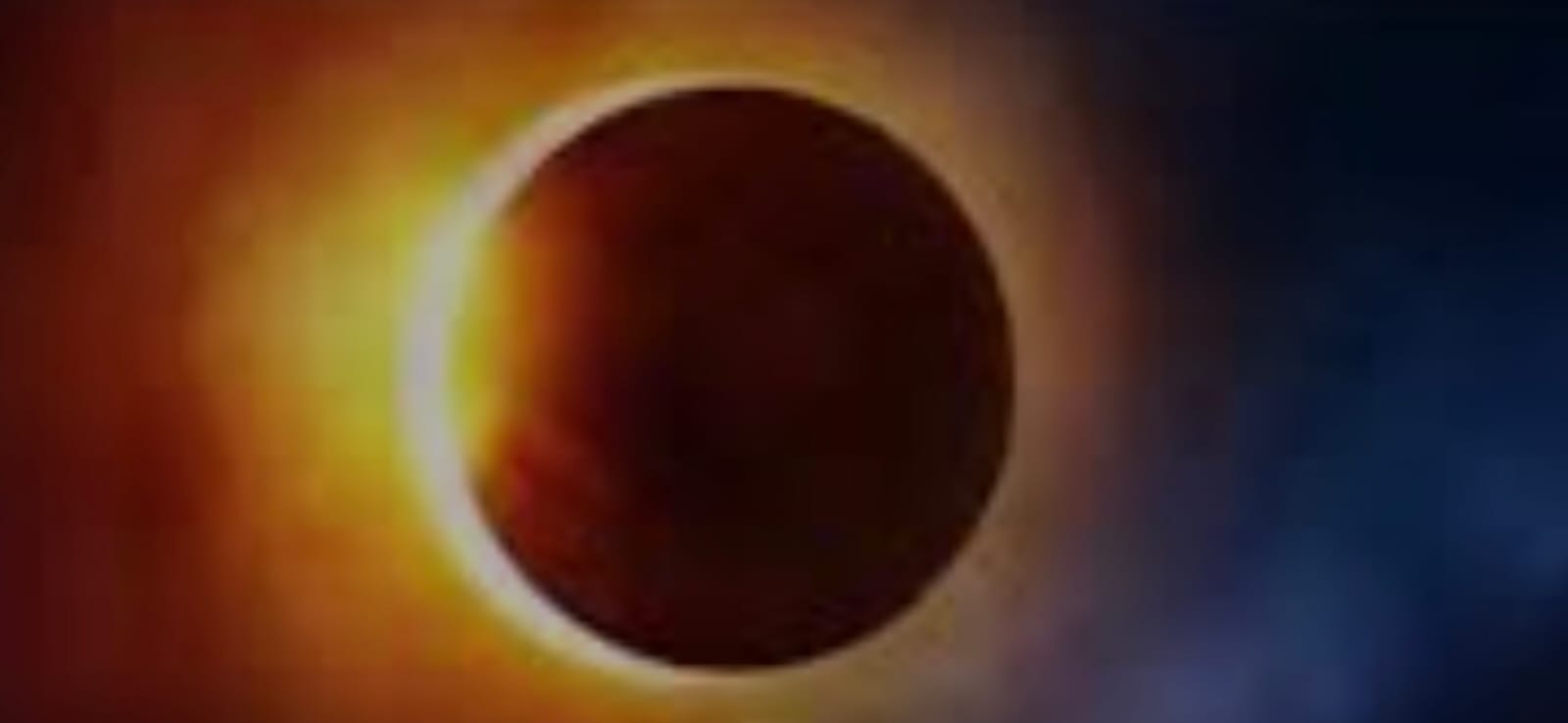
August 12, 2026, marked a rare celestial wonder eagerly anticipated by astronomers and skywatchers worldwide. On this day, a total solar eclipse occurred. A solar eclipse happens when the Sun, Moon, and Earth align closely, with the Moon passing directly between the Sun and Earth, blocking the Sun either completely or partially. What made this event particularly special was that it was a total solar eclipse.
However, this eclipse was not visible in India. The path of totality stretched across Greenland, Iceland, northern Russia, the Atlantic Ocean, Spain, and parts of Portugal. A partial solar eclipse was visible across many parts of Europe.
A Unique Experience in Britain
People in Britain also witnessed this celestial marvel. In London, the eclipse began at around 6:17 PM and reached its peak at approximately 7:12 PM. Roughly 90 percent of the Sun was obscured by the Moon's shadow in London. The Royal Observatory Greenwich explained that between 90 and 96 percent of the Sun was covered across regions of Britain and Ireland.
In areas where the total eclipse was visible, daytime briefly plunged into darkness. People were amazed by sudden changes in sunlight, a slight drop in ambient temperature, and temporary shifts in the behavior of birds and other animals.
How is an Eclipse Formed Scientifically?
A solar eclipse is a natural astronomical phenomenon with no supernatural forces involved. The Sun, Moon, and Earth constantly travel along their respective orbits. During a new moon, when the Moon passes between the Sun and Earth, its shadow falls on the Earth. Those located within the shadowed path can witness the eclipse. If the Sun is completely obscured in a small area under the Moon's shadow, it is called a total solar eclipse. If only a part of the Sun is covered over a wider area, it is termed a partial solar eclipse. During this event, there were regions where the total eclipse lasted for a maximum of about two minutes and 18 seconds.
Why Was It Not Visible in India?
Whenever a solar eclipse occurs, it is not visible from every part of the world. The path of the Moon's shadow across the Earth is very limited. Because this path remained far away from India, there was no opportunity to directly view the solar eclipse in our country. Although this was a significant event in terms of astronomy, it remained an un-viewable eclipse from Indian skies.
Traditional Beliefs vs. Scientific Outlook
In Indian culture, solar eclipses hold a special place. Since ancient times, eclipses have been viewed spiritually and religiously, leading to various observed customs. Traditions like chanting mantras, performing prayers, and taking ritual baths during the eclipse are common. However, scientifically speaking, an eclipse is a natural celestial event caused by the relative positions of the Sun, Moon, and Earth. There is no scientific evidence proving that an eclipse brings negative omens or adverse effects on humans. Respecting traditions is one thing, while understanding scientific facts is another; both need to be balanced.
Eye Protection is Paramount
Eye protection is essential when viewing a solar eclipse directly. Looking at the Sun with ordinary sunglasses, camera filters, or other makeshift items is dangerous. Except for the brief period during totality when the Moon completely covers the Sun, appropriate solar-viewing glasses or scientifically certified protective methods must be used during all other phases.
Lessons Taught by Nature
A solar eclipse is not just a breathtaking visual spectacle; it is a magnificent example of how orderly the universe operates. Scientists are able to calculate the exact positional relationship between the Sun, Moon, and Earth—sitting millions of kilometers apart—years in advance. This stands as a testament to human knowledge. Once a society that feared eclipses, humanity now studies the Sun using spacecraft, accurately predicting eclipse paths and informing people worldwide.
Fostering an Interest in Astronomy Among Children
Such celestial events provide a great opportunity to foster scientific thinking among children. Parents and teachers should encourage children to find answers to questions like: What is the Sun? How does the Moon revolve? What is the Earth's orbit? Why does an eclipse happen? We must cultivate knowledge rather than fear, encouraging youth to adopt traits like observation, questioning, and evidence-based thinking instead of superstition.
Conclusion
The solar eclipse of August 12, 2026, once again introduced the world to the magnificent order of the universe. While a total eclipse was visible from Greenland to Iceland and Spain, a partial eclipse appeared across many regions of Europe, though it skipped India. A solar eclipse should not be viewed as an event to be feared, but as a rare celestial lesson offered by nature, inspiring us to deepen our curiosity about the universe's secrets. Modern society must move forward by respecting science while properly understanding traditions. Every moment spent looking at the sky teaches us a new lesson: a solar eclipse is a wonder displayed by nature and a truth explained by science.