Trinet News – August 13, 2026
By Peri Nageswara Rao
The metro rail project has long been a key public transportation dream for the city of Vijayawada. Amidst rapid expansion, a growing population, and mounting daily vehicular congestion, there is an urgent need to establish a modern public transport system designed for future requirements. Consequently, the renewed focus on the Vijayawada Metro project has sparked significant interest among city residents.
Vijayawada stands out as one of the most crucial cities in Andhra Pradesh. It holds a special place as the state's political, commercial, educational, medical, and transport hub. The city already boasts strong connectivity via railways, roads, national highways, and an airport. However, with internal urban traffic congestion steadily rising, the need for a high-speed public transit system has become increasingly apparent.
The introduction of a metro rail would significantly reduce travel time between major parts of the city. Employees, students, business owners, and daily commuters would be able to reach their destinations in less time. Most importantly, the metro could play a pivotal role in reducing the volume of vehicles on the roads during peak hours.
Traffic congestion on Vijayawada's roads has increased notably. With two-wheelers, cars, auto-rickshaws, buses, and freight vehicles all sharing the same roadways, severe traffic bottlenecks are visible in several areas. As the city expands further in the future, this issue is likely to intensify, making long-term transportation planning essential from now on.
Building a metro rail project is a massive infrastructure undertaking. It requires heavy investment, land acquisition or alternative construction methodologies, technical expertise, and a comprehensive transportation plan. A specialized traffic management strategy must also be formulated to minimize public inconvenience during construction.
Scientific studies are required to address several core aspects: Where should the metro route run? Which areas should house the stations? In which direction is the city likely to expand in the future? How can the metro seamlessly connect key locations such as the railway station, bus stand, airport, educational institutions, hospitals, and commercial centers?
The Vijayawada Metro should not be viewed merely as a transport medium from one point of the city to another. It must function as an integrated part of the city's broader public transit network. The metro will only deliver its full benefits if it is coordinated with city buses, railways, auto-rickshaws, and other public transport modes.
Affordable ticket pricing is another critical factor. For the metro to be widely utilized by ordinary citizens, employees, and students, fares must not become a heavy financial burden. At the same time, a financially sustainable model must be established keeping project operations and maintenance costs in mind.
The metro rail can also yield environmental benefits. If people opt for public transit over personal vehicles, road traffic congestion will decrease, which in turn can lower fuel consumption and air pollution. Providing passengers with a fast and comfortable travel experience will also boost public trust in public transportation.
However, the metro project demands comprehensive study rather than hasty decisions. All factors—including the city's geographical conditions, population growth, passenger volume, construction costs, operational expenses, and future revenue—must be carefully taken into account. Since making modifications after construction begins is extremely costly, advance planning is paramount.
The arrival of the metro could inject fresh momentum into Vijayawada's development. Commercial activity around metro stations could increase, job opportunities could emerge, and connectivity across different parts of the city would improve. Nevertheless, the government must plan accordingly to ensure this development remains accessible to ordinary citizens.
The metro rail project is not just a construction program undertaken by the government; it is infrastructure built for future generations. Therefore, the project design must comprehensively address public needs, environmental protection, traffic challenges, financial viability, and future urban expansion.
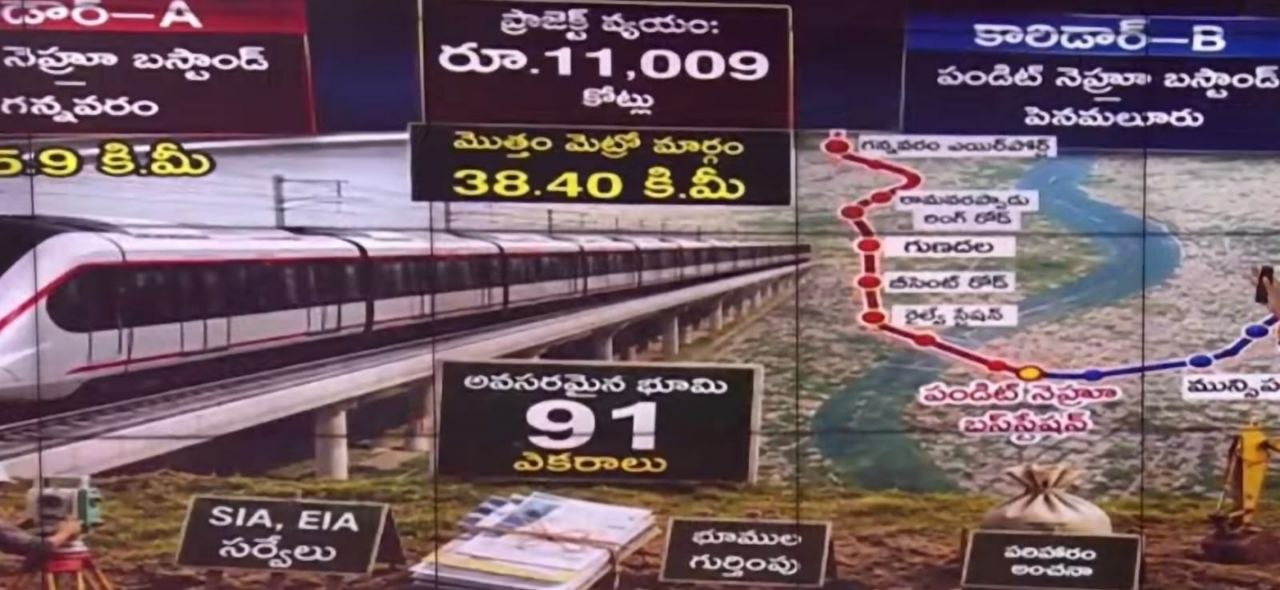
If the Vijayawada Metro project moves forward, city residents can look forward to fast and comfortable public transit. Putting a suitable transport system in place now can help prevent future traffic bottlenecks to a certain extent. The government should present a clear action plan to the public regarding the project and maintain transparency at every stage of construction, ensuring that essential information—such as project costs, routes, stations, and construction timelines—is readily available.
Overall, the Vijayawada Metro has the potential to stand as a landmark infrastructure project that transforms the city's future. Driven by proper planning, financial discipline, technical expertise, and public participation, this project can help shape Vijayawada into a more modern and convenient city.
Vijayawada Metro – A pathway for rapid transit and a new route to development!