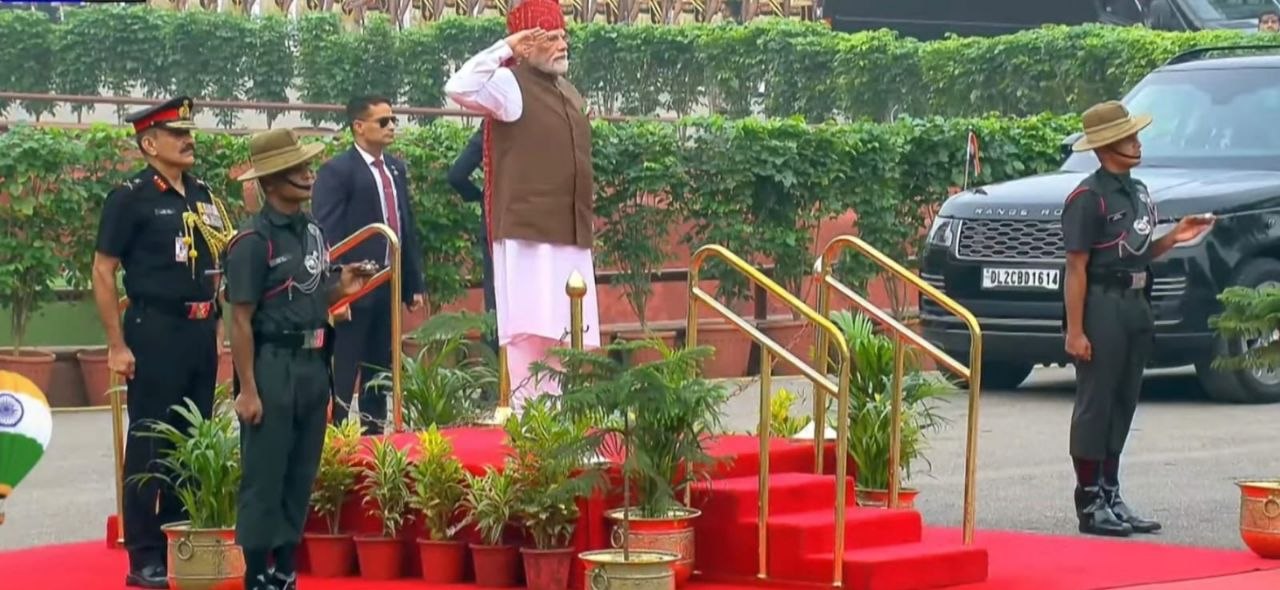
Prime Minister Modi's Call from Delhi's Red Fort: Seven Directions for a Developed India – PM's Appeal to Youth Power Trinet News | 15 August 2026 Analyst: Lion. Peri. Nageswara Rao Delhi's Red Fort holds a special place in the history of Indian independence. Every year on August 15, the Prime Minister of the country hoisting the national flag on the ramparts of the Red Fort and addressing the citizens is a great national tradition. As India celebrated its 80th Independence Day on August 15, 2026, Prime Minister Narendra Modi provided strategic direction to the nation from the Red Fort. This year's celebrations placed primary importance on the theme "Youth Power for Viksit Bharat @ 2047." At the same time, the 150th anniversary of 'Vande Mataram' lent special significance to the occasion. This speech made it clear that India, having completed an eight-decade journey since achieving independence, now stands at another crucial juncture. The Prime Minister once again placed before the nation the goal of positioning India as a developed country by the time it celebrates its centenary of independence in 2047. He appealed that this should not merely be a government objective, but should transform into the collective resolve of 1.4 billion Indians.
Tribute to Freedom Fighters Commencing his address from the Red Fort, the Prime Minister first remembered the great souls who sacrificed their lives for the country's freedom. He reminded the citizens that freedom is not a gift given by someone, but the result of the sacrifices of many generations. The Prime Minister's speech reflected the sentiment that the joint efforts of freedom fighters, soldiers, farmers, laborers, women, youth, scientists, entrepreneurs, and common citizens have built today's India. In this context, 'Vande Mataram' received special prominence. Marking its 150-year historical journey, 'Vande Mataram' was specially performed for the first time on the Red Fort stage during the Independence Day celebrations.
2047 – The Goal of a Developed India India's Prime Minister made it clear that small goals are no longer sufficient for India. To transform the country into a developed India by 2047, rapid changes are needed in every sector. He suggested that India must enhance its capabilities across all sectors: economy, manufacturing, agriculture, education, healthcare, defense, technology, energy, infrastructure, and employment. He expressed the aspiration that India should not merely remain a market for the world, but emerge as a powerhouse supplying goods, technology, and skills required globally.
Youth Power is the Country's Future The element that received the highest importance in the 2026 Independence Day message was the youth. The Prime Minister stated that India's biggest strength is its young population. He expressed his desire for Indian youth to stay ahead globally in areas like new ideas, emerging technologies, research, artificial intelligence, manufacturing, startups, and space research. He appealed that the youth should not merely wait for jobs, but rise to a level where they create jobs. The speech indicated the direction of creating more opportunities for Indian youth in the global job market through skill development. It can be said that India's future will not be shaped merely in government offices, but in the dreams of students studying in schools, the thoughts of the youth, the hard work of farmers, the self-reliance of women, and the labor of workers.
Developed India in Seven Directions To transform the country into a developed nation, the Prime Minister mentioned a seven-pronged plan called "Saptadhara." He explained the need to move forward by coordinating aspects such as technology, infrastructure, human resources, economic strength, national security, and inclusive development. These seven directions must become a collective action plan for nation-building, not just a government program. The 2047 goal is achievable only if the Centre, states, local bodies, industries, farmers, youth, and women all become active participants.
Another Step Towards Atmanirbhar Bharat A special emphasis on indigenous products and self-reliance was visible in the Prime Minister's speech. The Prime Minister noted that India, which once depended on foreign nations for many goods, is now rising to a level where it supplies products to the global market. He explained that domestic manufacturing has increased in sectors like mobile phones, defense products, electronics, railway coaches, and Khadi. He delivered a message that pride in "Made in India" goods must grow within every Indian. If domestic manufacturing increases, jobs increase. If jobs increase, family incomes increase. If income increases, the domestic market strengthens. If the market strengthens, industries get more opportunities. Thus, self-reliance becomes a strong foundation for the economy.
India's Thrust in Semiconductors Semiconductors have become a vital sector in the modern world. Chips are needed in every sector, from mobile phones to vehicles, and from medical equipment to defense technology. The Prime Minister announced that production has already begun in three semiconductor manufacturing facilities in India, and the country is moving towards operationalizing another seven to eight facilities in the near future. This is not just industrial expansion; it is a crucial step towards technological self-reliance. This sector will be immensely useful for India to play a key role in the global supply chain in the future.
Artificial Intelligence – New Power for a New World Artificial Intelligence is rapidly changing the world. The Prime Minister called for India to emerge not just as a consumer country of this technology, but as a creator. He mentioned the goal of connecting lakhs of youth with AI training in the coming year. This reflects the objective of ensuring that modern education and technical training are accessible to youth from poor and middle-class families as well. AI may change the nature of jobs, but at the same time, it will bring opportunities for new jobs, new businesses, and new skills. Youth need to understand this change beforehand and prepare themselves.
Nuclear Energy – Priority for Energy Security Continuous electricity is necessary for India to develop. Energy is needed for every sector—industries, agriculture, transport, cities, villages, and digital systems. The government is also pushing forward with the goal of massively increasing nuclear energy capacity. Strengthening energy security alongside increasing clean energy sources is crucial for future India. Reducing dependence on fuel imports, enhancing domestic energy capacity, and balancing environmental protection—these three goals must go hand in hand.
Firm Message on Naxalism The Prime Minister also gave a clear message on issues related to the country's internal security. He stated that armed Naxalism and Maoist violence, which affected certain parts of the country for decades, have now reached their final stage. He remembered the security personnel who sacrificed their lives in this fight. However, he warned that people must remain vigilant against attempts to promote violent ideologies in society. The Prime Minister once again strongly voiced from the Red Fort that there should be no compromise on national security.
New Generation in Politics The Prime Minister expressed his desire for a new generation of leadership to emerge in Indian democracy. He appealed for youth, even from non-political family backgrounds, to enter politics. He stated that politics should not be restricted to a few families, but should become a platform that provides opportunities to every talented youth. This is a matter that will lead to interesting discussions in Indian democracy. If youth enter politics, new ideas, new policies, and new leadership can emerge. At the same time, experience, ideology, public service, and moral values are equally necessary in the democratic system.