
New Delhi, Trinet News, 4th of November:
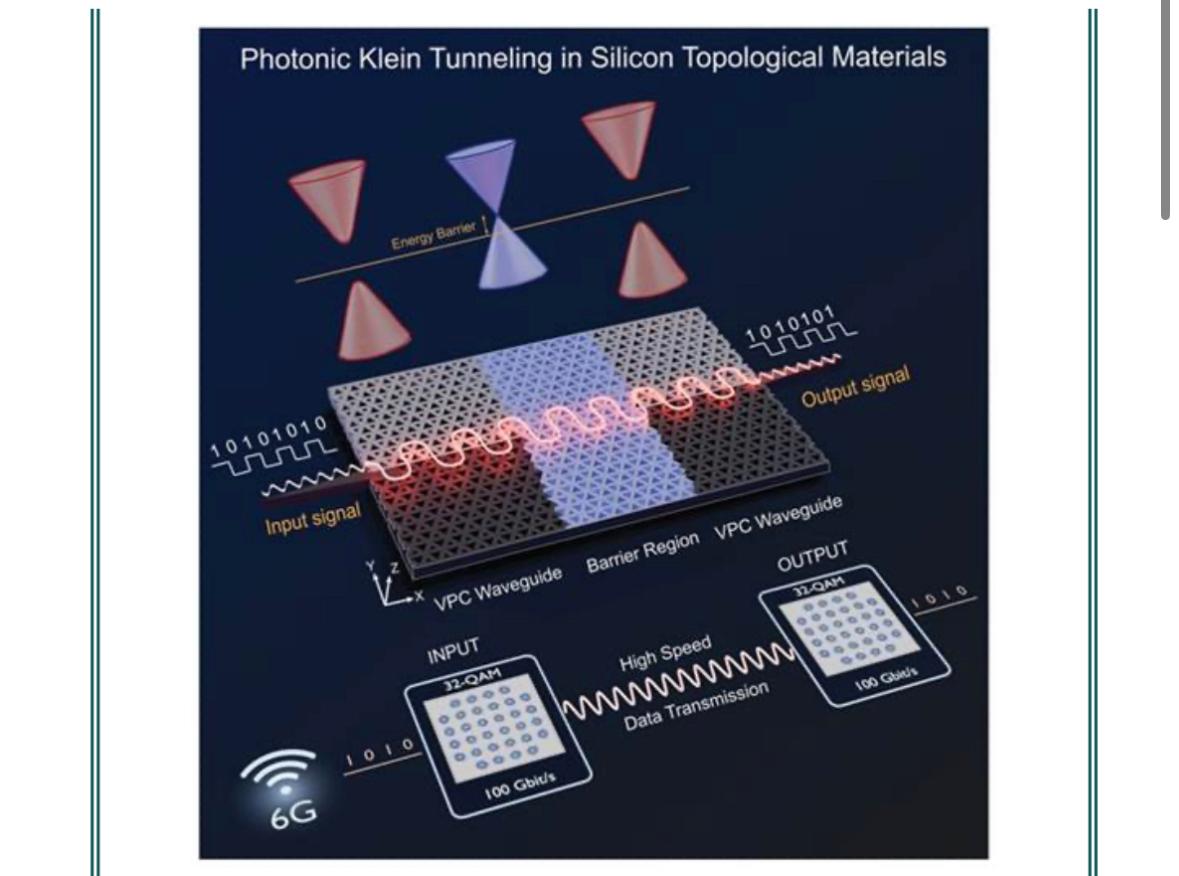
The latest silicon chip for the development of future 6G information systems has been developed by researchers from Jawaharlal Nehru Centre for Advanced Scientific Research (JNCASR) to enable them to break through a specially designed barrier with minimum loss of terahertz waves, delivering up to 100 gigabits per second.
The terahertz frequencies between microwaves and infrared light provide a wide bandwidth that is likely to be used in future 6G networks, but the signal will weaken due to sudden changes in structure or distortion of waves in small circuits.
To overcome this problem, the researchers arranged triangular holes on silicon plates in a special order to create a photonic crystal. The method of topological photonics enabled waves to travel along a specified path.
The two-barrier device, four sharp turns and an Omega-shaped device that divides the signal into two branches were tested. They transmitted 48, 60, 100 gigabits of data per second respectively.
The research was led by Dr Abhishek Kumar, Assistant Professor of JN CASR and Head of Meta Optics Laboratory. Samina Mulla and Sangram Kumar Saathu were the first co-authors.
The research will contribute to the development of circuits that can redirect and divide terahertz signals at low losses on a single chip. In the next phase, researchers will test the possibilities of controlling obstacles with electrical, thermal or mechanical methods and changing the path of signal travel as required.