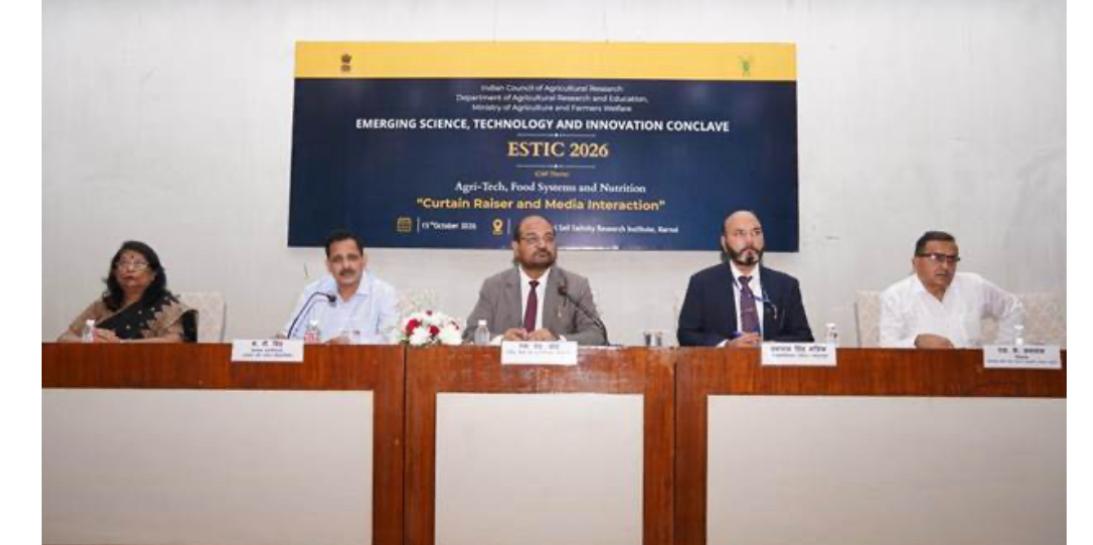
New Delhi, 15 October (Trenet News): Dr. M L Jatt, Director General of Agricultural Research and Education Department of the Indian Council of Agriculture Research (ICAR) has clarified that the results of agricultural research should not be limited to laboratories but reach farmers' fields.
Speaking at the STIC2026 Preparatory Meeting and Media Interview held on Thursday at ICAR Centre for Soil Salinity Research (CSSRI) in Karnal, Haryana, he also outlined the role of ICCA in Agricultural Technology, Food Systems and Nutrition at the Emerging Science, Technology & Innovation Conclave to be held from 27-29 October in Bharat Mandha, New Delhi.
12 major technological exhibitions
He said that Science Ministries, Research Institutes, Startups and other partners will participate in STIC 2026. The exhibition will showcase the scientific and technological progress on a total of 12 key areas.
From genetic modification to agricultural mechanization
Jatt said that ICAR focuses on genetically modified crop varieties, nutritional enhancements, climate resilient agriculture, integrated vegetation conservation and garden crop diversification. He said research is also ongoing in animal health, fisheries, natural resource management and agricultural mechanization.
He said that the first two genetically modified rice varieties in the world and the first complete crop reference genome map in the country will showcase research achievements. Last year, ICAR developed 117 garden crop varieties which are contributing to nutritional security with increased nutrient values and integrated farming practices.
Artificial intelligence for soil health
Soil Intelligence: AI and Pedological Science will demonstrate the use of artificial intelligence in soil studies. He said that these technologies would be useful for assessing soil characteristics, efficient utilization of resources and crop planning.
He said that research is underway on the production of green ammonia using hydrogen generated by solar power.The meeting also highlighted exhibitions held in 10,000 acres across six states, with collaboration from ICAR, Ministry of New Renewable Energy and other partners.
Connection of agriculture to health
He also mentioned the Seeth Programme jointly developed by ICAR and Indian Council of Medical Research to link agriculture, food and human health. He said that nutritionally enhanced crops and integrated farming practices will be key in this.
The exhibition will also feature innovations such as research on domestic vaccines for the prevention of cattle diseases, conservation of domestic livestock species, cultivation of ducks in saline areas and cotton cutting machines.
Earlier, the Director of CSSRI had described the organization's efforts in identifying, restoring and managing salt-affected soils, water management and salinity resistant crop varieties. The aim of this initiative was to inform people about the role of science and technology in food nutrition security, farmer prosperity and sustainable agricultural development.