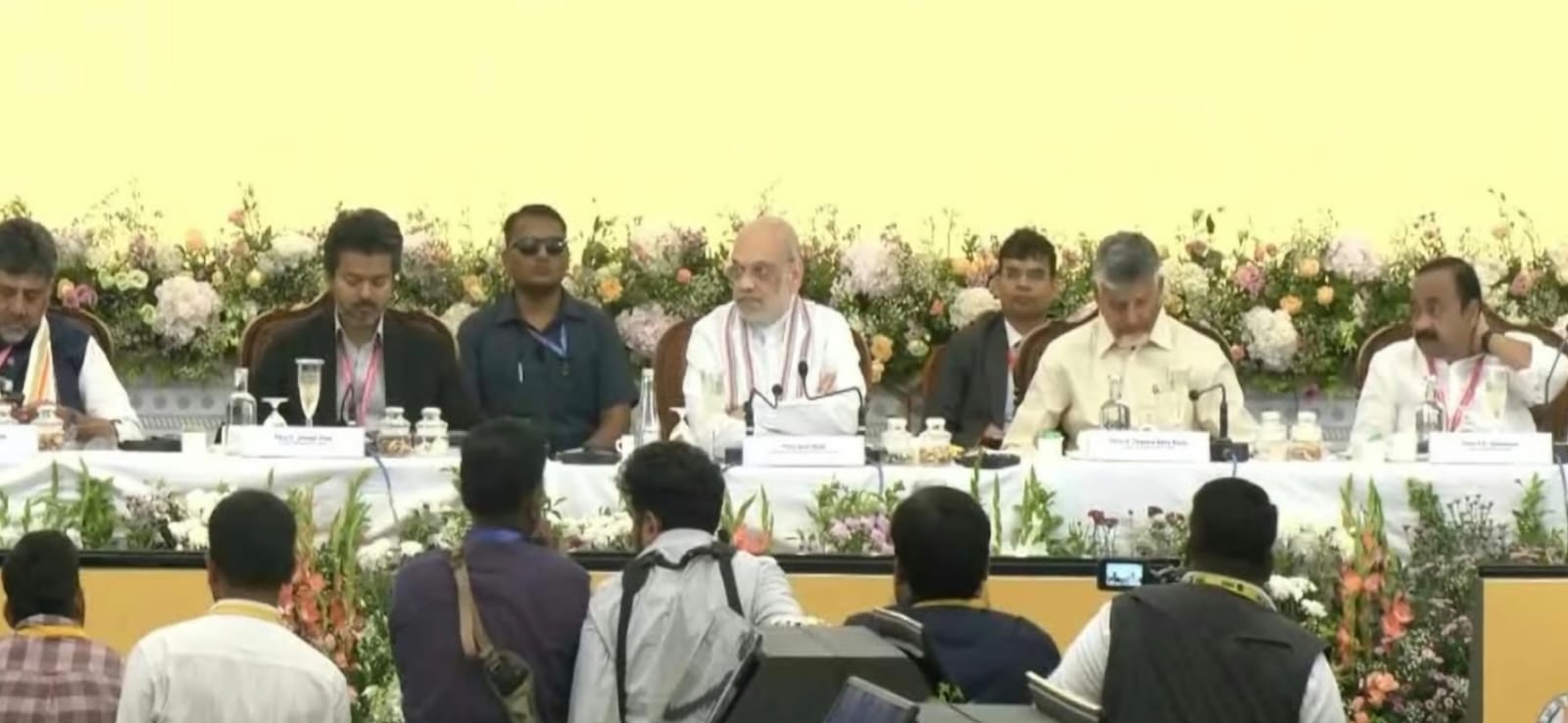
TRINET NEWS — 22 AUGUST 2026: Southern state chief ministers and Union Home Minister Amit Shah engaged in extensive discussions regarding southern state issues, inter-state disputes, development initiatives, Centre-state relations, river water sharing, constituency delimitation, education, healthcare, and security. The 31st meeting of the Southern Zonal Council, held near Mahabalipuram in Tamil Nadu, gained significant attention in political and administrative circles. This meeting acquired utmost importance as several key issues concerning southern states have been awaiting resolution for years.
Representatives from Andhra Pradesh, Karnataka, Kerala, Tamil Nadu, and Telangana, along with the union territories of Puducherry, Lakshadweep, and Andaman and Nicobar Islands, participated in the meeting. The primary objective of the meeting was to enhance coordination between the Centre and the states, and to find amicable solutions to inter-state disputes.
Andhra Pradesh Chief Minister N. Chandrababu Naidu reportedly raised development-related issues concerning the state, along with river linking and infrastructure development. Southern state leaders expressed their views that mutual cooperation is essential for state development and that fair treatment should be ensured by the Centre.
Karnataka Chief Minister D.K. Shivakumar brought issues such as the political representation of southern states, river water disputes, and funds due from the Centre to the attention of the meeting. The primary discussion revolved around ensuring that southern states, which have successfully implemented population control, do not lose out in the future due to constituency delimitation. Several leaders expressed concern that the voice of southern states should not be weakened within the democratic system.
Tamil Nadu Chief Minister Joseph Vijay drew Union Home Minister Amit Shah's attention to several critical issues. Tamil Nadu clearly stated its views on the Cauvery water dispute, the Mekedatu project, the NEET examination for medical education admissions, and constituency delimitation. The consensus in the meeting was that southern states should not be politically penalized for achieving success in population control.
Kerala Chief Minister V.D. Satheesan explained the need to further strengthen regional cooperation. He suggested that southern states should work collectively in areas such as river water management, transport connectivity, environmental protection, coastal security, and disaster management. He opined that increased cooperation among states would accelerate development.
Representing Telangana, Deputy Chief Minister Mallu Bhatti Vikramarka attended the meeting. State representatives expressed their views on issues concerning Telangana, Centre-state relations, and regional development. The meeting observed that many problems faced by the southern states are interconnected, necessitating the exploration of solutions through joint discussions.
River water disputes were a major topic of discussion during the meeting. Issues like Cauvery and Mekedatu have long been contentious between Tamil Nadu and Karnataka. The concerned states strongly presented their arguments for fairness in river water distribution. Several participants suggested finding permanent solutions to these problems while respecting Supreme Court and tribunal orders.
Similarly, the issue of constituency delimitation emerged as a critical matter. Concerns were raised that if delimitation is carried out based on population, the parliamentary representation of southern states—which are at the forefront of population control—could decrease. The chief ministers requested the Centre to make decisions without penalizing states that have achieved better results in development and population control.
Several education sector issues were also discussed. Tamil Nadu requested that the special circumstances of the states regarding the NEET exam be taken into consideration. State leaders opined that the Centre should make appropriate decisions to prevent any reduction in opportunities for rural and underprivileged students.
On the other hand, issues related to southern state security, illegal drug trafficking, coastal security, and the containment of terrorist activities were also discussed. Since crimes committed in one state have the potential to spread to another, participants suggested enhancing information sharing, police coordination, and cooperation with central agencies. The establishment of special fast-track courts for trying crimes against women was also discussed. It was opined that the states and the Centre should take effective measures together to provide swift justice to victims.
Overall, the southern states' summit chaired by Amit Shah served not merely as a political gathering, but as a platform for resolving mutual issues. The uniqueness of this meeting lay in chief ministers from diverse political parties coming onto a single platform to place their states' interests and the concerns of southern citizens before the Centre. The meeting reiterated that strengthening the federal spirit and resolving inter-state differences through dialogue is essential for Indian democracy.
Decisions made regarding the development of southern states, political representation, river water distribution, education, health, and security are likely to impact national politics in the future. The true benefits of this crucial meeting will reach the people only if the central and state governments take follow-up action on the issues discussed in Amit Shah's presence. Discussing problems is one thing, while showing permanent solutions is quite another. In that direction, hope is expressed that this meeting will herald a new era of cooperation among the southern states.