40 to 90 Percent Subsidies and Government Support for Horticultural Crops
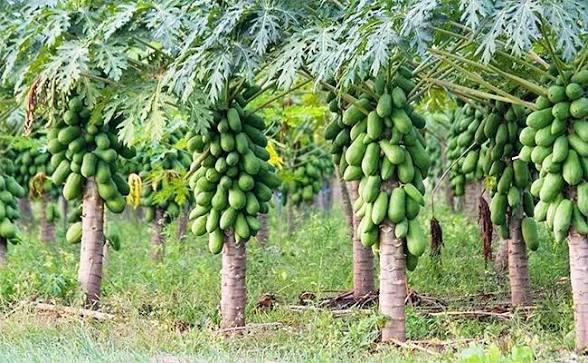
Hyderabad, Trinet News, September 19: Farmers in the state are showing increasing interest in papaya cultivation. The government's schemes, subsidies, and marketing facilities aimed at promoting horticultural crops are successfully attracting growers. Factors such as quick yields, steady market demand, and various incentives provided by the Horticulture Department are encouraging farmers to shift towards this crop.
According to statistics from the Horticulture Department, 3,862 farmers are currently cultivating papaya across 7,609 acres statewide. District-wise, Sangareddy stands first, followed by Rangareddy in second place.
High Yields in a Short Period
Farmers are focusing on papaya due to its year-round market demand and quick harvest cycle. In areas with adequate water availability, scientific cultivation methods can yield high returns, prompting some farmers to choose papaya as an alternative to traditional crops. Proximity to Hyderabad offers a massive consumer market, which greatly benefits papaya cultivation in nearby districts. Easy access to markets and good transportation facilities are cited as reasons for the larger cultivation areas in Sangareddy and Rangareddy districts.
Encouragement Through Subsidies
The government provides subsidies to farmers under various schemes to promote horticulture. With financial assistance ranging from 40% to a maximum of 90%, the initial investment burden on farmers is significantly reduced. Assistance is provided in line with scheme regulations for various agricultural needs. Officials advise farmers to make full use of these subsidies, use quality saplings, and follow scientific farming methods. Water management, fertilizer application, and pest control are highlighted as crucial elements in papaya farming.
Since papaya offers returns in a shorter duration compared to traditional crops, farmers are keenly interested. However, officials advise that cultivation requires careful advance planning regarding soil nature, water availability, quality planting material, pest control, and market prices. Additionally, support is being provided for saplings, fertilizers, mulching, agricultural wells, farm ponds, drip irrigation, and sprinkler systems. Banks are extending loans to papaya farmers according to specified unit costs.
Market Facilities
Market facilities for the sale of papaya, other fruits, and vegetables are available in Warangal, Khammam, and Gaddiannaram. There is a need to further strengthen transportation, storage, and sales systems to move the produce to nearby markets post-harvest. The availability of market infrastructure allows farmers to utilize alternative centers to sell their produce. Farmers demand that marketing systems operate efficiently as production increases.
Meanwhile, officials stated that papaya production for the 2025-26 period is projected to reach 1,68,570 metric tonnes. Across 32 districts in the state, 3,862 farmers are cultivating papaya on 7,609 acres. This includes 870 farmers cultivating 1,658 acres in Sangareddy district, 696 farmers with 1,180 acres in Rangareddy, 500 farmers with 1,124 acres in Khammam, and 166 farmers with 387 acres in Nagarkurnool.
The Agricultural and Processed Food Products Export Development Authority (APEDA) is implementing a Financial Assistance (FA) scheme to promote fresh fruit and vegetable cultivation in the state. The program aims to expand the area under horticulture and encourage farmers to adopt high-value crops. With incentives available for crops like papaya, cultivation areas are expected to grow further.
Horticulture experts suggest that providing technical guidance from crop selection to cultivation, harvesting, and marketing will further expand papaya farming. Farmers are advised to plan their sales strategies in advance, keeping potential market price fluctuations in mind. Although the area under papaya cultivation is growing, ensuring stable income for farmers will depend heavily on the supply of quality saplings, pest control, scientific farming methods, post-harvest management, and robust marketing facilities.